
Building strong and well-shaped arms requires a proper biceps workout routine that focuses on correct form, balanced volume, and consistent training. The biceps are one of the most visible upper-body muscles, and training them correctly not only improves arm size but also enhances pulling strength and overall physique.
This in-depth guide covers everything you need to know, including muscle anatomy, effective exercises, training frequency, and a structured biceps workout plan for all fitness levels.
What Is a Biceps Workout?
A biceps-focused training routine targets the muscles located on the front of the upper arm. These muscles play a major role in elbow flexion and forearm rotation, making them essential for everyday movements and strength training exercises.
Main Muscles Involved
- Biceps brachii (long head & short head)
- Brachialis
- Brachioradialis
Training all three muscles helps develop full, thick, and powerful arms.
Benefits of Training Your Biceps
Including dedicated arm exercises in your fitness routine offers several advantages:
- Improves arm size and definition
- Enhances pulling strength
- Supports compound lifts
- Boosts grip and forearm power
- Improves upper-body aesthetics
Strong arms also help prevent joint strain during heavy workouts.
Understanding Biceps Anatomy
Knowing how your muscles work allows you to train more effectively.
- Long head – Creates the visible arm peak
- Short head – Adds width to the arms
- Brachialis – Increases overall arm thickness
A balanced routine should stimulate all these areas for best results.
Most Effective Exercises for Biceps Growth
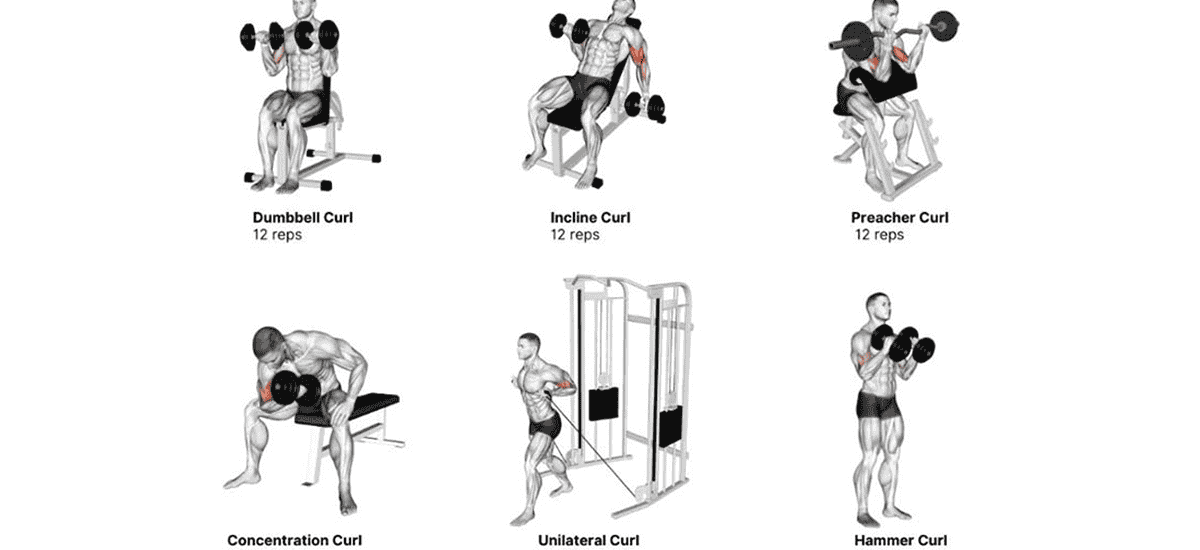
1. Barbell Curl
One of the most effective movements for building arm strength.
Key benefits:
- Allows heavier loads
- Targets both heads evenly
2. Dumbbell Curl
Ideal for muscle balance and isolation.
- Improves range of motion
- Helps correct left-right strength differences
3. Hammer Curl
Excellent for arm thickness and forearm development.
- Targets the brachialis muscle
- Improves grip strength
4. Preacher Curl
Provides strict form and constant tension.
- Reduces cheating
- Enhances muscle control
5. Concentration Curl
Perfect for focused contraction.
- Builds muscle peak
- Improves mind-muscle connection
Biceps Workout Plan (Gym-Based)
Below is a structured training plan based on experience level.
Beginner Biceps Workout Plan
Frequency: 1–2 times per week
- Dumbbell Curl – 3 × 12
- Hammer Curl – 3 × 12
- Preacher Curl – 3 × 10
✔ Rest 60–90 seconds
✔ Focus on technique
Intermediate Biceps Workout Plan
Frequency: 2 times per week
- Barbell Curl – 4 × 10
- Incline Dumbbell Curl – 3 × 12
- Hammer Curl – 3 × 12
- Concentration Curl – 3 × 10
✔ Use controlled tempo
✔ Progressive overload
Advanced Biceps Workout Plan
Frequency: 2–3 times per week
- Barbell Curl – 4 × 8
- EZ-Bar Preacher Curl – 4 × 10
- Incline Dumbbell Curl – 3 × 12
- Cable Curl (Drop Set) – 3 rounds
- Hammer Curl – 3 × 15
🔥 Advanced intensity techniques:
- Drop sets
- Slow negatives
- Supersets
Ideal Sets and Reps for Biceps workout
- Muscle size: 8–12 reps × 3–4 sets
- Strength: 4–6 reps × 4–5 sets
- Endurance: 12–15 reps × 2–3 sets
Choose weights that challenge you while maintaining proper form.
Common Training Mistakes to Avoid
Avoid these errors to maximize results:
❌ Lifting too heavy
❌ Using momentum
❌ Skipping warm-up and stretching
❌ Training arms daily
❌ Ignoring rest and nutrition
Smart training leads to better growth.
Tips to Grow Bigger Arms Faster
- Maintain full range of motion
- Squeeze muscles at peak contraction
- Control the lowering phase
- Consume enough protein
- Sleep at least 7–8 hours
- Train arms after back workouts for better pump
At-Home Arm Training (No Equipment)
You can still train effectively without gym equipment:
- Resistance band curls – 4 × 15
- Towel curls using door anchor – 3 × 12
- Isometric curl holds – 3 sets
Consistency matters more than equipment.
How Long Does It Take to See Results?
With proper training, nutrition, and recovery:
- 4–6 weeks: Strength improvement
- 8–12 weeks: Visible muscle growth
- 6 months: Major arm transformation
Patience and discipline are key.
Conclusion
A well-designed arm training routine focuses on form, progression, and recovery rather than excessive volume. By following a structured plan and staying consistent, you can build strong, defined, and muscular arms over time.
Train smart, eat well, and stay committed.